


Improving the EN Development Process
Overview
CEN and CENELEC are evolving the EN development process to make it more efficient, predictable, and fit for today’s fast-paced standardization environment.
The objective is clear: deliver high-quality European Standards faster, without compromising consensus, inclusiveness or technical excellence.
This is achieved by streamlining voting stages, reducing administrative steps, and enabling more parallel work.
Why this initiative?
Standardization operates in a fast-moving environment where timely delivery of standards is essential. While the EN development process is robust, certain steps can be optimized, as voting and administrative phases may be lengthy and sequential activities can delay progress.
This initiative addresses these challenges by reducing unnecessary delays, preserving time for quality drafting and consensus-building, and shifting the focus from administrative tasks to technical work.
What will change?
The improvements focus on making the process leaner and more efficient, while preserving flexibility where needed.
1. Earlier start of drafting
- Working Groups may begin drafting in parallel with New Work Item approval
👉 Benefit: Time gains at the very beginning of projects.
2. Shorter voting phases
- Duration of New Work Item approval vote reduced to 4 weeks, with possibility to extend to up to 8 weeks when justified and decided by TC leadership before launch
- Duration of and Formal Vote reduced to 4 weeks
👉 Benefit: Faster decision-making.
3. More parallel activities
- Translation of ENQ drafts into French and English begins after editing and in parallel with a national preparation period of 4 weeks;
- Enquiry can start with the English version only, while translations continue in parallel;
- Translation of FV draft takes place in parallel with FV
👉 Benefit: Reduced overall project duration without increasing workload.
4. A new default pathway: from Enquiry to Publication
- After a positive Enquiry, the default route will be direct publication
- Formal Vote becomes the exception, only required when technical changes are introduced after Enquiry as agreed by the TC
- Within 6 weeks after Enquiry, the TC confirms the next step (publication, FV, or other)
👉 Benefit: Significant time savings and reduced procedural burden, while ensuring that technical integrity is preserved when changes are needed and cannot wait for a future revision.
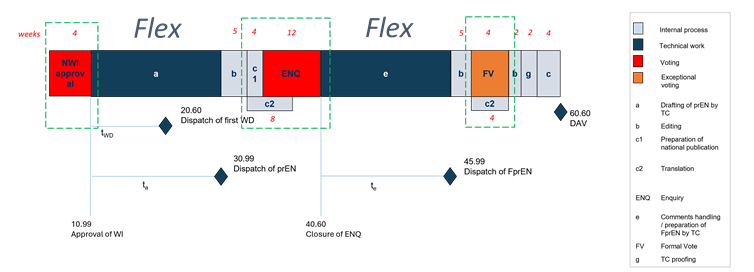
Implementation timeline
The improvements will be introduced in two phases:
Batch 1 – Q4 2026
- The vote duration for the adoption of New Work Items (NWI) and for the creation or activation of Preliminary Work Items (PWI) is set to 4 weeks but can exceptionally be extended up to 8 weeks when decided by the TC leadership before the launch of the ballot/vote
- A period for the preparation of the national consultations after CCMC editing is set to 4 weeks and is followed by Enquiry
- Translation of Enquiry drafts into French and German starts in parallel with the national preparation period and is set to 8 weeks (4 weeks of national preparation period and first 4 weeks of Enquiry period)
- Enquiry is launched with the English version only, unless the translation is available at the moment of the launch;
- The Formal Vote duration is set to 4 weeks
- Translation of Formal Vote draft takes place in parallel with Formal Vote.
Batch 2 – Q1 2027
- The WG responsible for the drafting of a NWI may start drafting in parallel with the NWI approval ballot/vote
- Publishing directly after a positive Enquiry vote, provided that all comments have been considered and that there are no technical changes agreed upon by the TC. If technical changes are introduced in the final draft by the TC, Formal Vote is requested
- Within 6 weeks from the closure of the positive ENQ, the TC shall inform CCMC about the next steps (go to publication, launch FV, other procedure). CCMC will proceed to publication in case no TC feedback is received within 6 weeks.
These changes will apply to:
- All New Work Items, and
- Drafts entering relevant stages after each batch is implemented.
What does this mean for Technical Committees?
These improvements are designed for you and with you in mind:
✅ Focus on technical work rather than administrative steps
✅ Faster delivery of standard
✅ Greater flexibility where needed
At the same time, your core role remains unchanged 👉 ensuring high-quality, consensus-based standards.
Frequently Asked Questions
Learn more
Webinars
Dedicated webinars are offered to support implementation, with dedicated time for Q&A.
Participation is mandatory for TC Secretaries, TC Chairs, WG Convenors, WG Secretaries, and Project Leaders, and is encouraged for TC members and WG experts.
👉 Register for one of the two webinars 'EN Development Process - First batch of changes':